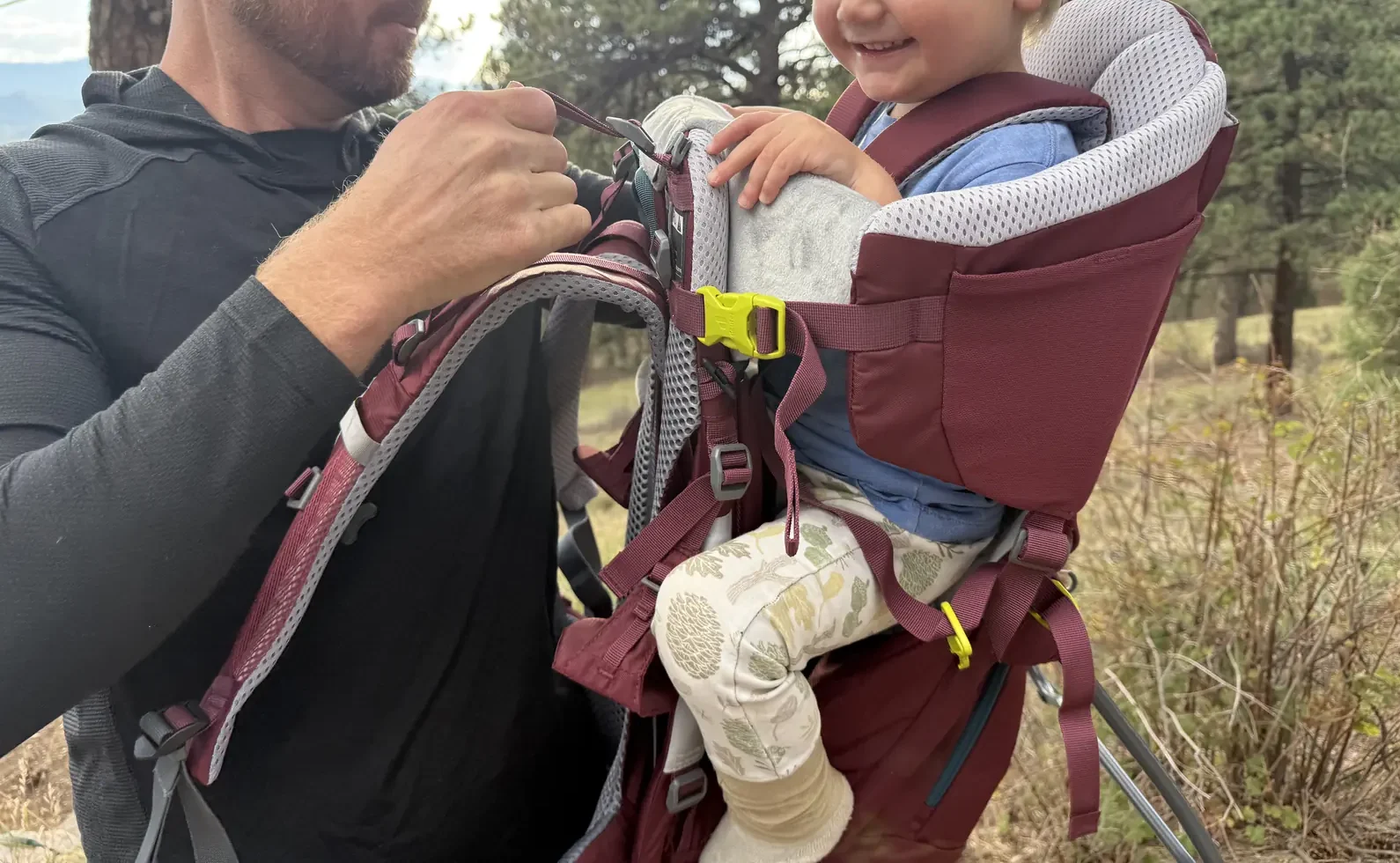
Tested on Real Trails With Our Own Kids
Prices verified at time of publication.
Have you ever tried carrying a toddler up a trail in your arms? We have. On the Watchman Trail in Zion National Park, Cypress flat out refused to ride in the carrier we had at the time, so one of us carried him the whole way up. It was extremely difficult. And that’s the whole problem in a nutshell: a carrier only works if your kid will actually ride in it, and if the person carrying is uncomfortable, you’re going to have a bad time too.
We’ve tested dozens of carriers with our kids over the years, from Baja California Sur, Mexico, up to Waterton Lakes National Park in Canada. For this guide, we narrowed it down to our five favorites built for the trail, and tested the current version of each with kids from about 10 lb up to about 39 lb. Our top pick is the Deuter Kid Comfort, which we’ve been using in one version or another for years now. Working with a tighter budget? Jump to the Osprey Poco Soft.
The 5 Best Child Carrier Backpacks for Hiking at a Glance
The Deuter Kid Comfort is the one we’d tell most families to buy. The Poco Premium and the Kelty scored dead even; the Poco Premium gets the nod because our kids were more comfortable in it, and child comfort counts most.
 Rank 1
#1 BEST (best all-around)
Best child carrier backpack overall
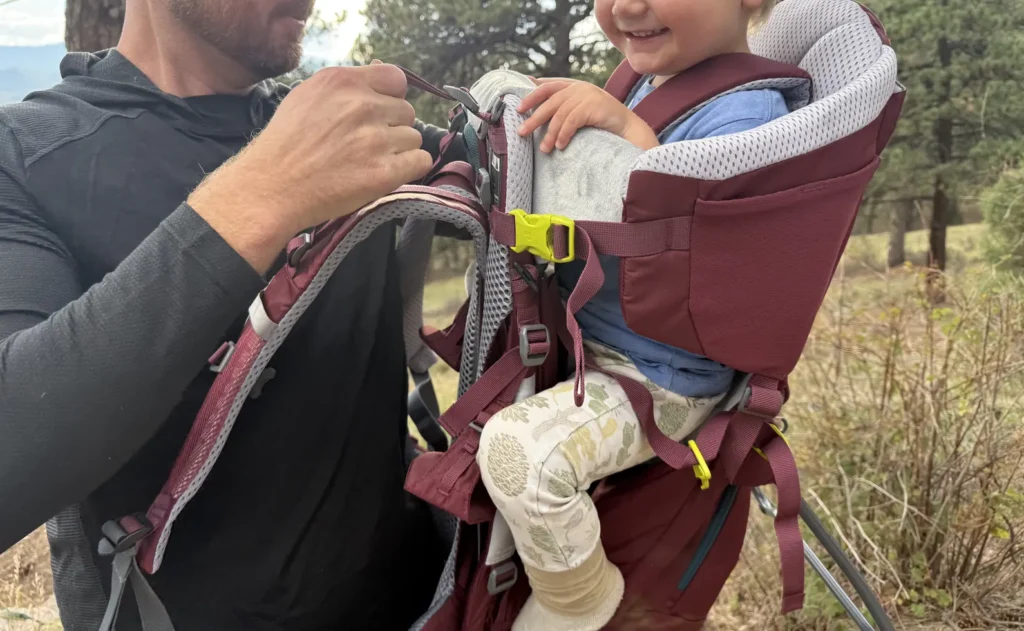
Deuter Kid Comfort
The one we'd grab for just about any hike. It's comfortable for whoever's carrying and whoever's riding, comes with stirrups and a sunshade, and has enough pockets for the stuff you actually need.
 Rank 2
#2 BETTER (runner-up)
Best for long days and nappers
Osprey Poco Premium
The nap machine. Tons of storage, and a sunshade with mesh sides our kids almost always fall asleep under. The catch: fiddly plastic toggles on that sunshade, and it's a lot of carrier to fit in the trunk.
 Rank 3
#3 GOOD (budget buy)
Best for features and organization
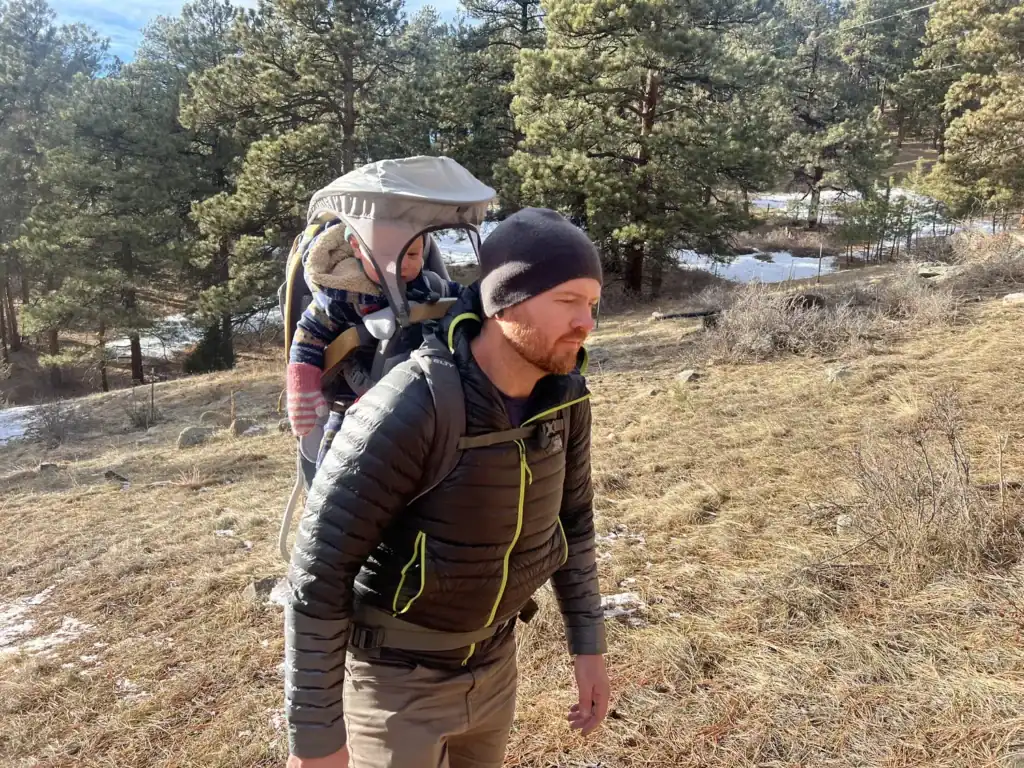
Kelty Journey PerfectFIT Elite
The one with a pocket for everything, even the muddy stuff. Tons of storage, smart little features, and a torso you can adjust while you're wearing it. Buckling in a wiggly kid takes some patience, though.
And the Rest…
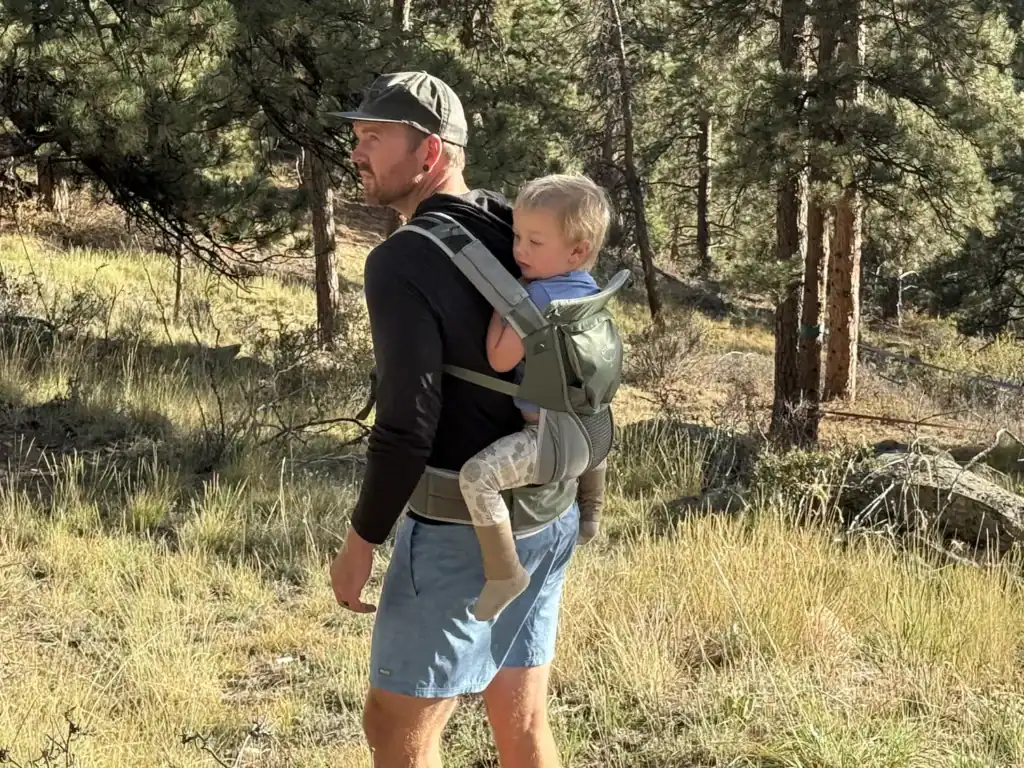
#4. Best budget child carrier for hiking
Read our reviewOsprey Poco Soft
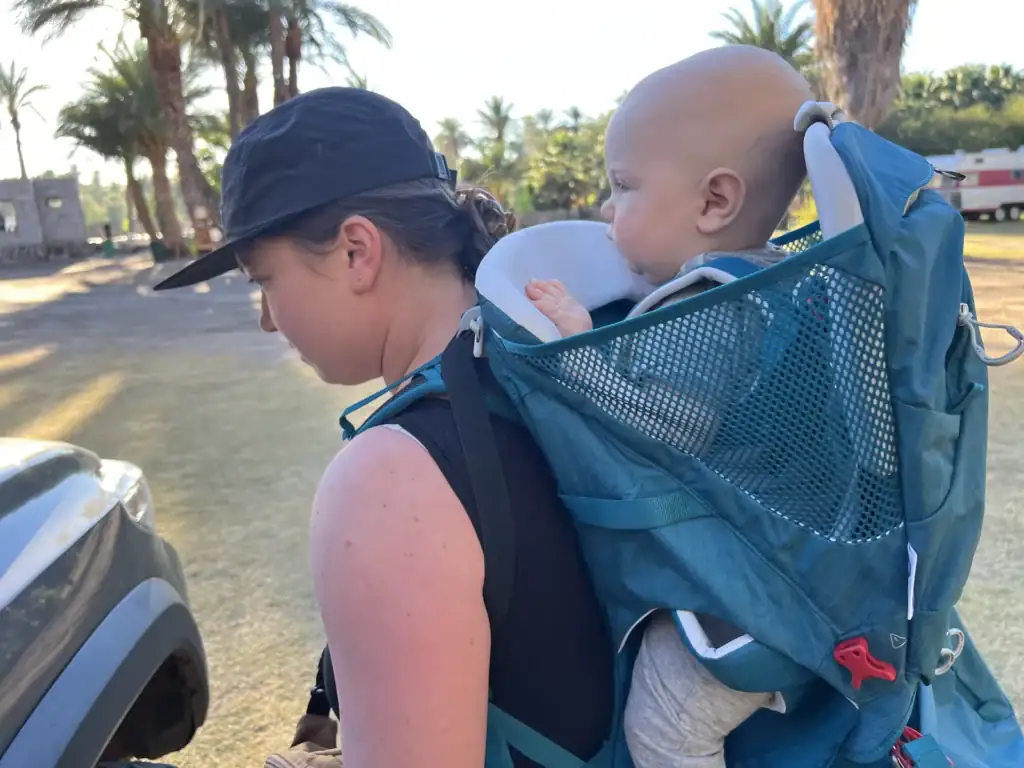
#5. Best for travel
Read our reviewOsprey Poco SLT
How We Tested and What Matters Most
Child comfort matters most. If your kid won’t ride happily, nothing else about the carrier really matters.
We’ve tested dozens of carriers over the years, and these five are the ones that earned their spot. We tested the current version of each one with kids from about 10 lb up to about 39 lb. Our younger son Oren, who’s about 29 lb, did most of the riding. His big brother Cypress, at about 38 to 39 lb, took short rides in the Deuter, Kelty and Poco Premium to test the upper limits. We both wore every carrier, so we know how they adjust for more than one grown-up.
Here’s what we looked at, in order of how much it counted toward each score:
- Child comfort (25%). Do they complain? Ask to get out? Refuse to get in when you pull it out of the car? Stirrups made a big difference for our kids.
- Wearer comfort (20%). How well the back panel vents (or doesn’t), how much weight the hip belt takes off your shoulders, how the shoulder straps feel, and how well it adjusts for different grown-ups. The hip belt matters more as your kid gets heavier, but it matters for little ones too.
- Ease of use (15%). How easy it is to get your kid in and out, and to put the sunshade up and down. You’ll do this a dozen times a hike, so it adds up.
- Features (15%). What comes in the box and what costs extra: stirrups, sunshade, rain cover, mirror, a removable and washable drool pad or chewable strap covers, and hip belt pockets. For us a sunshade is non-negotiable. The Colorado sun is no joke, and we like the kind that stows inside the pack and pops out without clipping anything on.
- Weight and packability (15%). Say your kid weighs 25 lb. Add a framed carrier, snacks, diapers and water, and that number climbs fast. A framed carrier also takes up a lot more room in the car than a soft one.
- Storage (10%). How much it holds, and where. Is there a water bottle your kid can reach? An insulated pocket for bottles or snacks? A bottle pocket for you, or better yet, a hydration sleeve?
We didn’t score price, but we list it on every card. These are expensive. Our framed picks run $280 to $450, and an accessory sold separately can change the real cost.
You’ll also notice a lot of Osprey here. That’s because they make a carrier for just about every kind of family: soft, lightweight framed and fully loaded.
Framed vs. Soft: Which Do You Need?
Go framed for real trail days and heavier kids. Go soft for lighter kids, shorter outings, and trips where every bit of space counts.
| Framed (Deuter, Kelty, Poco Premium, Poco SLT) | Soft (Poco Soft) | |
|---|---|---|
| Carrier weight | 4.72 to 8.34 lb | 1.68 lb |
| Upper limit | 40 to about 48.5 lb, depending on how each brand counts it | 33 lb |
| Sun protection | A real shade that sits above your kid | A hood that sits right on their head |
| Heat | Space between you and your kid | Kid pressed right up against you |
| Storage | Room for water, snacks and diapers | A pocket for the essentials |
| Kickstand | Yes, on every one we tested | No |
The first time we hiked with a framed carrier, it was kind of a whole new world. Suddenly there was room for the snacks and diapers, and no hot little body stuck to our back on the climb. But a soft carrier packs down to almost nothing, and it weighs about as much as a water bottle.
Here’s our rule of thumb: soft for lighter kids and shorter outings, framed once they get heavy. Past about 33 lb, a soft carrier gets uncomfortable fast without a frame to carry the load. That’s not a knock on soft carriers. It’s just how they work.
Which Version Should You Buy?
We’ve tested most of the Deuter, Kelty and Osprey lineups over the years. The five above are the ones we’d buy again. The rest are nice, just close enough to our picks that there was no real reason to feature them.
| Model | Price | How it compares | In this guide |
|---|---|---|---|
| Deuter Kid Comfort | $330 | Our top pick, and the best of all worlds in Deuter’s lineup for the price | #1 |
| Deuter Kid Comfort Active | $280 | A lighter, more streamlined Kid Comfort with fewer features. No sunshade in the box. | Tested, not featured |
| Deuter Kid Comfort Active SL | $280 | The Kid Comfort Active in a women’s-specific fit | Tested, not featured |
| Deuter Kid Comfort Pro | $390 | The premium version with everything included: an integrated day pack, a built-in sunshade and a rear-view mirror. We always found the high headrest a little weird, though. | Tested, not featured |
| Kelty Journey PerfectFIT | $299.95 | The lightest, most streamlined Kelty, with the least storage and no hip belt pockets. Same PerfectFIT suspension, though. | Tested, not featured |
| Kelty Journey PerfectFIT Signature | $369.95 | Kelty’s middle tier, with stirrups, an integrated sunshade and hip belt pockets. It skips the Elite’s lined dirty-gear compartment and hydration sleeve. | Not tested |
| Kelty Journey PerfectFIT Elite | $399.95 | Our pick for features and organization, and the only one in Kelty’s lineup with a hydration sleeve | #3 |
| Osprey Poco | $400 | Lighter than the Poco Premium, with less storage, a more basic design, a smaller hip belt and a little less padding | Tested, not featured |
| Osprey Poco LT | $340 | Close to the Poco SLT, but with more storage, a built-in pull-out sunshade and stirrups. Still built lighter than the Poco. | Tested, not featured |
| Osprey Poco Premium | $450 | Our pick for long days and nappers | #2 |
| Osprey Poco Soft | $160 | Our budget pick | #4 |
| Osprey Poco SLT | $280 | Our pick for travel | #5 |
What About Cheaper Carriers?
We get it, these carriers are expensive. We’ve tried a couple of the budget options on Amazon too, and we can’t recommend them. The materials just didn’t feel like they’d hold up to real trail use, and our kids weren’t comfortable in them. On one of them, the plastic hub the kickstand locks into snapped the second time we used it. Could we have been a little rough on it? Maybe. But a part that breaks that easily on something you’re carrying your kid in wasn’t something we were comfortable recommending.
If price is the sticking point, the Osprey Poco Soft at $160 is the one we’d point you to.
The 5 Best Child Carrier Backpacks for Hiking Tested
Rank 1
#1 BEST (best all-around)
Best child carrier backpack overall
Deuter Kid Comfort
The one we'd grab for just about any hike. It's comfortable for whoever's carrying and whoever's riding, comes with stirrups and a sunshade, and has enough pockets for the stuff you actually need.
Pros
- Easiest carrier to get a kid in and out of
- Vents well for you and your kid
- Sunshade and stirrups included
Cons
- No mesh sides on the sunshade
- No water bottle pocket you can reach
- Sunshade has no pocket of its own
Weight: about 7.1 lb (3,230 g) | Max load: about 48.5 lb (22 kg) of kid plus about 4.4 lb (2 kg) of gear | Fits caregivers: about 5’2″ to 6’5″ (158 to 195 cm) | Tested with: Oren, age 2, about 29 lb, plus short rides with Cypress at about 39 lb
Not right for you if: You need maximum storage (look at the Poco Premium or the Kelty), or your kid naps a lot and you want a sunshade with mesh sidewalls (that’s the Poco Premium).
Honestly, the Deuter and the Kelty are almost tied. The Kelty has more features and more storage. But the Deuter is easier to get a kid in and out of, carries more comfortably, and vents better for everybody. When you do it a dozen times a hike, that’s what matters. And it costs about $70 less.
This is the one our two-year-old can climb into by himself. We unclip the side, he hops right in, and when we’re done he gets himself back out the same way. No more fishing his legs down through those little gaps.
We both wore this one, and it’s easy to dial in for whoever’s carrying. Deuter lists it for adults from about 5’2″ to 6’5″ (158 to 195 cm), so most caregivers will be covered. If you’re on the shorter or slimmer side, Deuter’s Kid Comfort Active SL is built for that. The kid’s side is just as adjustable, and the cockpit harness is easy to tweak as your kid grows between hikes.
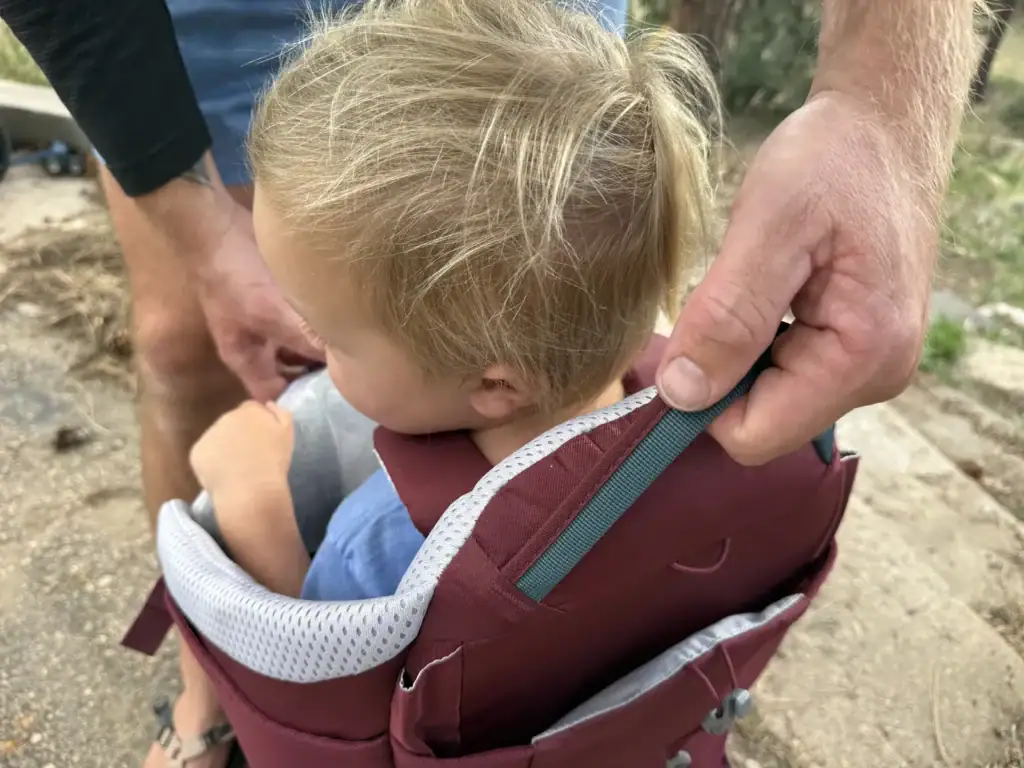
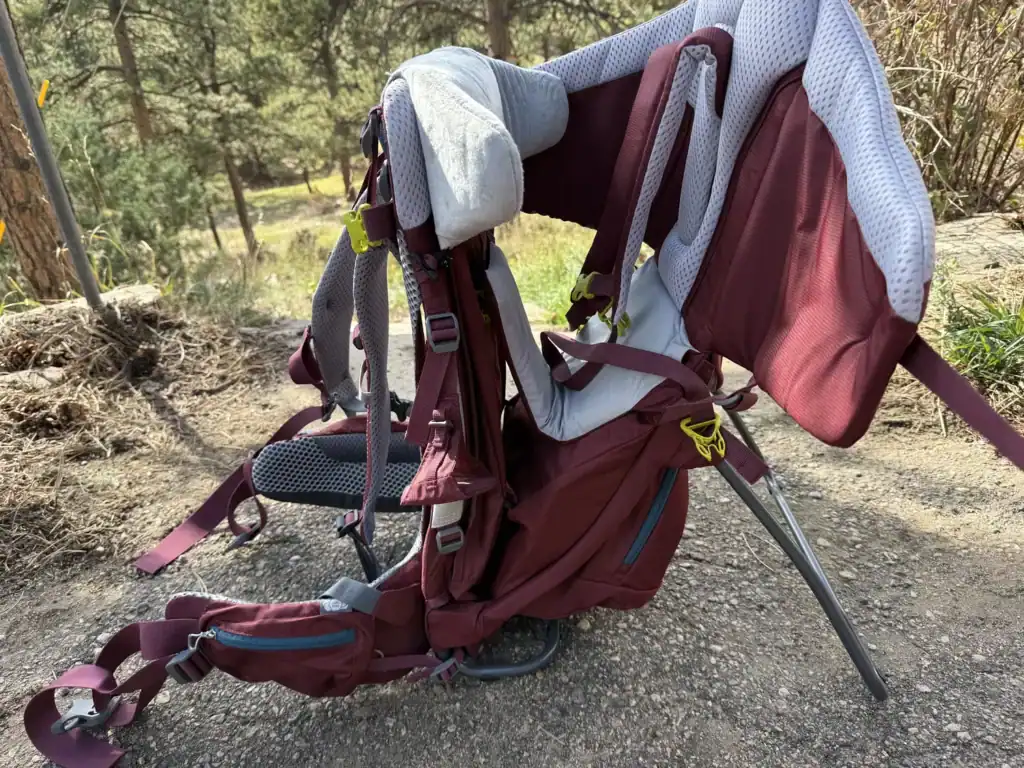
The short version: The easiest carrier to live with, for you and your kid. It’s not the most loaded, but it’s the one we’d tell most families to buy.
 Rank 2
#2 BETTER (runner-up)
Best for long days and nappers
Osprey Poco Premium
The nap machine. Tons of storage, and a sunshade with mesh sides our kids almost always fall asleep under. The catch: fiddly plastic toggles on that sunshade, and it's a lot of carrier to fit in the trunk.
Pros
- Most storage in the guide
- Mesh-sided sunshade made for naps
- Mirror included
Cons
- Heaviest carrier in the guide
- Fiddly sunshade toggles
- Bulky, even folded
Weight: 8.34 lb | Load range: 23.7 to 48.5 lb | Volume: 36 L | Torso adjustment: 6 in | Tested with: Oren, age 2, about 29 lb, plus short rides with Cypress at about 39 lb
Not right for you if: You don’t want to carry the heaviest carrier in the guide, you won’t actually use all that storage, or $450 is a stretch. And if small, fiddly clips are tough on your hands, whether from arthritis or anything else that affects grip, those plastic sunshade toggles will test your patience.
The Deuter is our pick for most people. But if we’re being honest, the Poco Premium is the one our family reaches for most, because it holds so much. The catch is that you have to be willing to carry all of it. At 8.34 lb before you put anything in it, this is the heaviest carrier in the guide.
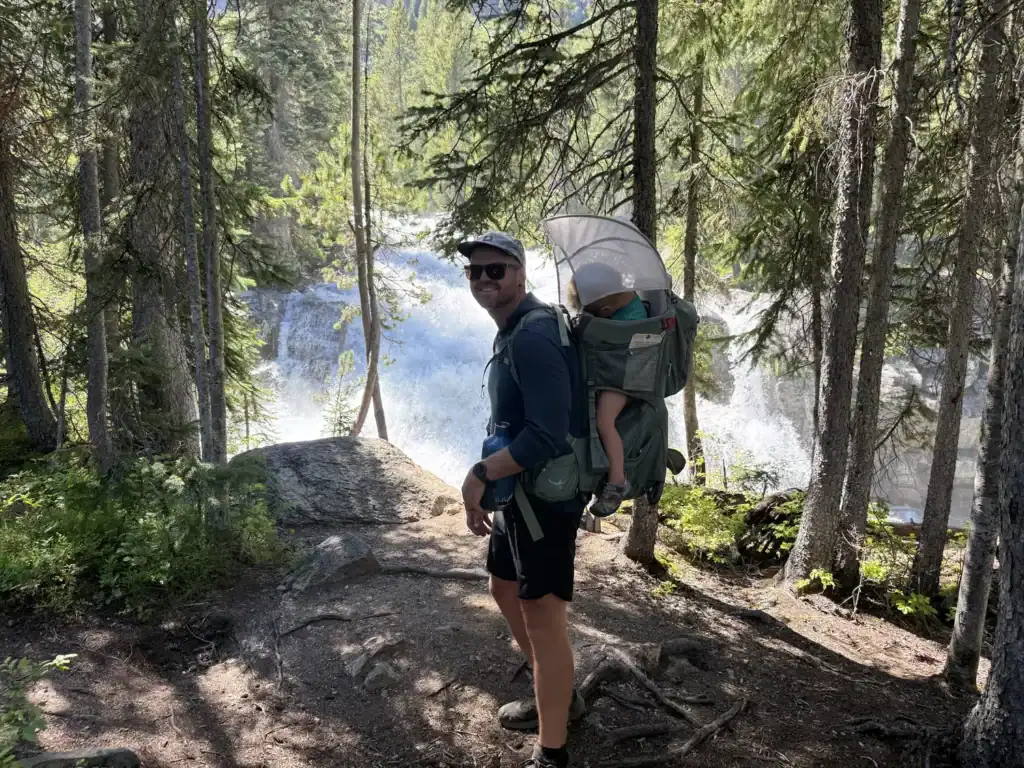
This past summer in Idaho’s Sawtooth Mountains, we took the boat shuttle across Redfish Lake and hiked up to the Lily Pond and Redfish Lake Creek Falls. Oren rode in the Poco Premium and snoozed the entire time. He was so cozy he slept right through the waterfall.
The sunshade has mesh sidewalls, and our kids almost always fall asleep leaning against them. On the Deuter, a sleepy head ends up on the chin pad instead. That alone makes this one hard to beat for long days.
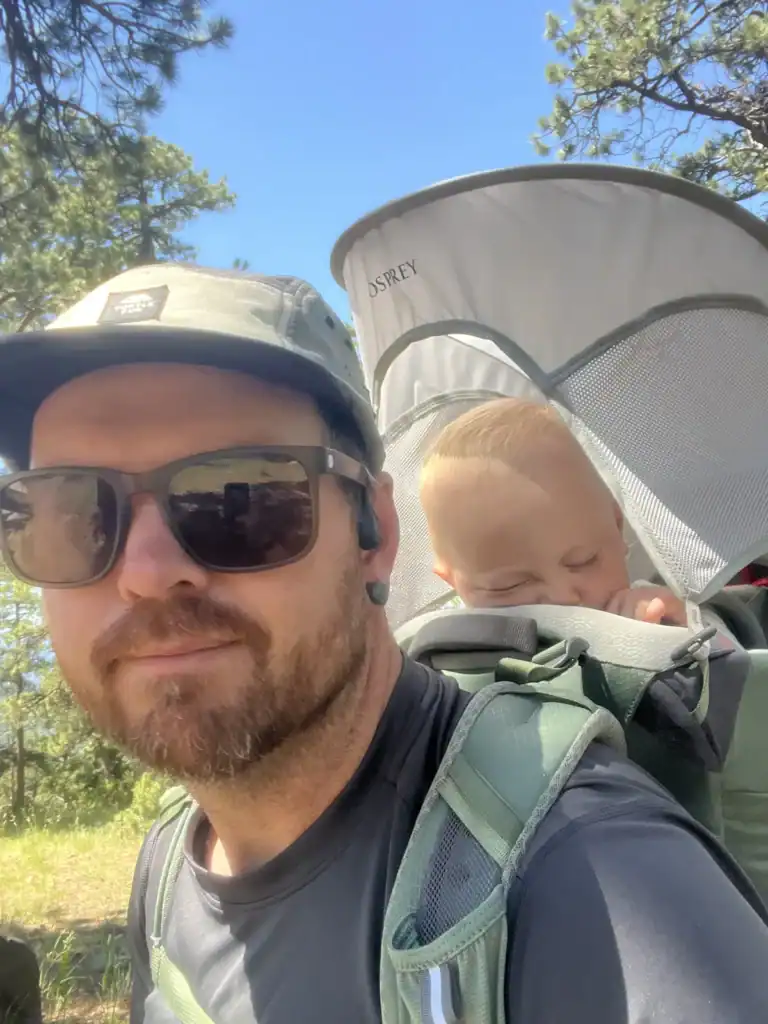
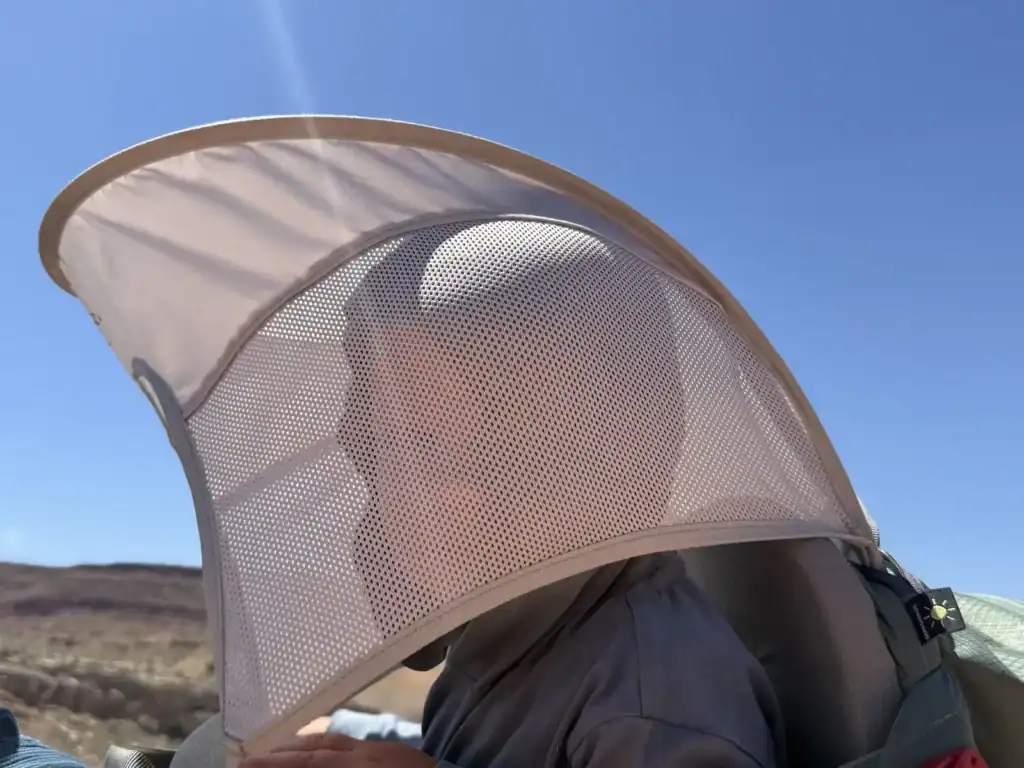
The short version: The nap machine with room for everything. It’s heavy and bulky, but for big days with a sleepy kid, it’s the one we grab.
Rank 3
#3 GOOD (budget buy)
Best for features and organization
Kelty Journey PerfectFIT Elite
The one with a pocket for everything, even the muddy stuff. Tons of storage, smart little features, and a torso you can adjust while you're wearing it. Buckling in a wiggly kid takes some patience, though.
Pros
- Pockets everywhere, including one for dirty gear
- Torso adjusts while you're wearing it
- Sunshade stows in its own pocket
Cons
- Harness is tricky once your kid is in
- Back panel runs warm
- Lots of straps and bulk
Weight: 7 lb 4 oz | Max load: 48.5 lb (kid, gear and pack) | Child weight: 16 to 40 lb | Torso fit: 15.5 to 21 in | Tested with: Oren, age 2, about 29 lb, plus short rides with Cypress at about 39 lb
Not right for you if: You won’t use all those features. The handles, straps and extra storage are great when you need them, but if you won’t, why carry the extra bulk and weight? Skip it if you run hot and want a back panel that breathes better, and skip it if your kid is already pushing 40 lb, Kelty’s maximum child weight.
The Kelty is the most feature-packed carrier we tested. It has way more storage than the Deuter, a sunshade that stows in its own pocket, and a soft harness our kids were comfy in. It came this close to the top spot.
What held it back is getting your kid in and out. Clipping and adjusting the harness once they’re in the cockpit can be a real challenge. And every time we lifted Oren out, it pulled his shoes right off.
On the Maxwell Falls Trail outside Evergreen, Oren fell into some truly nasty creek mud. Muddy clothes, a sopping wet diaper, the works. This is where the Kelty’s lined dirty-gear compartment earned its keep. Everything went straight in, zipped shut, and we dealt with it at home. When we were done, the pocket wiped right out.
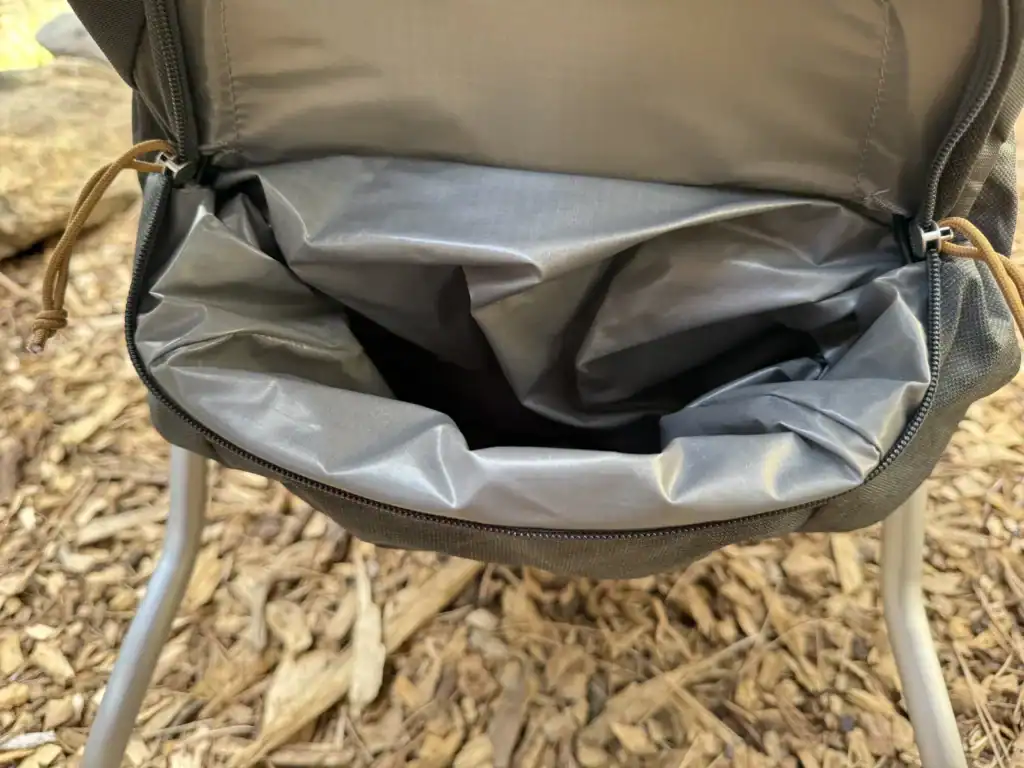
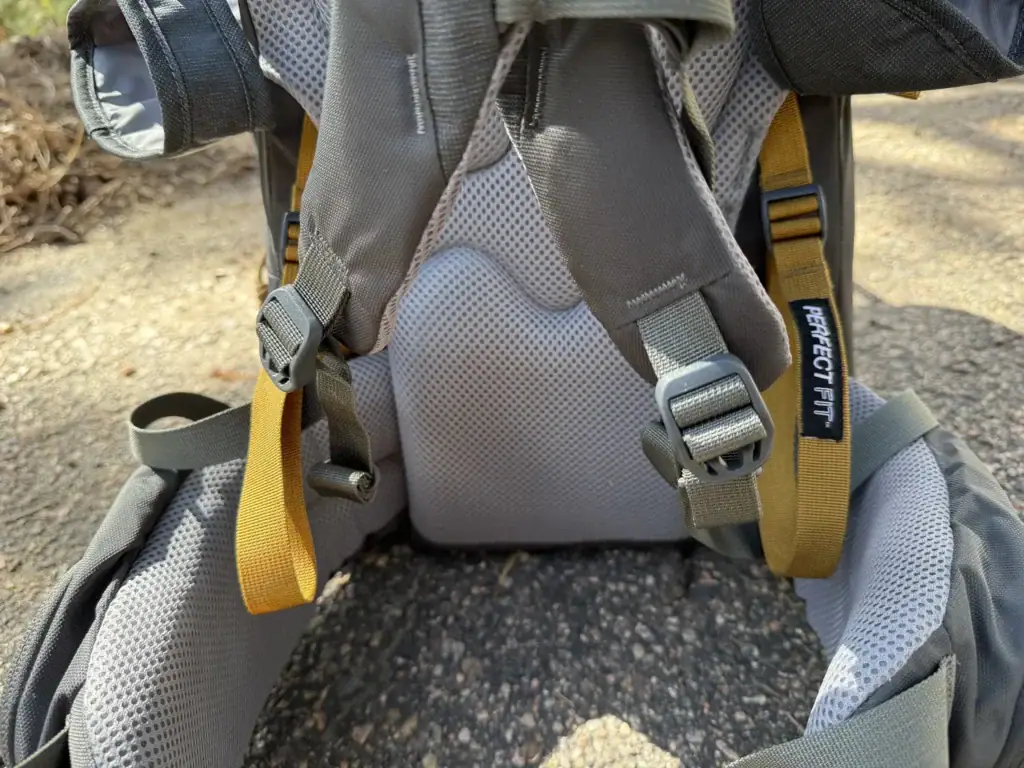
The short version: The most feature-packed carrier we tested, with a pocket for everything. If you can live with a fussier harness, it’s a great pick.
Read our more in-depth review of the Kelty Journey PerfectFIT Elite
Rank 4
#4. Best budget child carrier for hiking
Osprey Poco Soft
The soft carrier that actually gets hiking. A supportive hip belt, a pocket for the essentials, and it weighs next to nothing. Just don't count on it to carry your water.
Pros
- Weighs under 2 lb
- Supportive hip belt
- Whole thing is machine washable
Cons
- Nowhere to carry water
- Sun hood, not a real shade
- Tops out at 33 lb
Weight: 1.68 lb | Load range: 7 to 33 lb | Carry positions: 3 (back carry for about 12 to 36 months) | Tested with: a friend’s 10 lb baby up to Oren, age 2, about 29 lb
Not right for you if: Your kid is pushing past 33 lb. That’s not a knock on the Poco Soft, just the reality of soft carriers. Without a frame, carrying more than that would get uncomfortable fast.
With this one, yes. Osprey calls it the first authentic, outdoor performance soft carrier, and it’s the one we’d actually take up a trail. The hip belt is wide, padded and really supportive, and there’s a pocket on the front of it for the essentials. Most soft carriers don’t give you even that much.
We spent a good chunk of a Utah desert trip lugging Oren around in it on our backs. He did great. It got hot, though. That’s just the trade-off with any soft carrier, since your kid is pressed right up against you. Still, it was comfy enough for both of us.
Care couldn’t be easier. Osprey says the whole carrier is machine washable, including the removable drool pads on the straps. Our tip: toss it in a mesh laundry bag first so the buckles and straps don’t snag on anything in the washer.
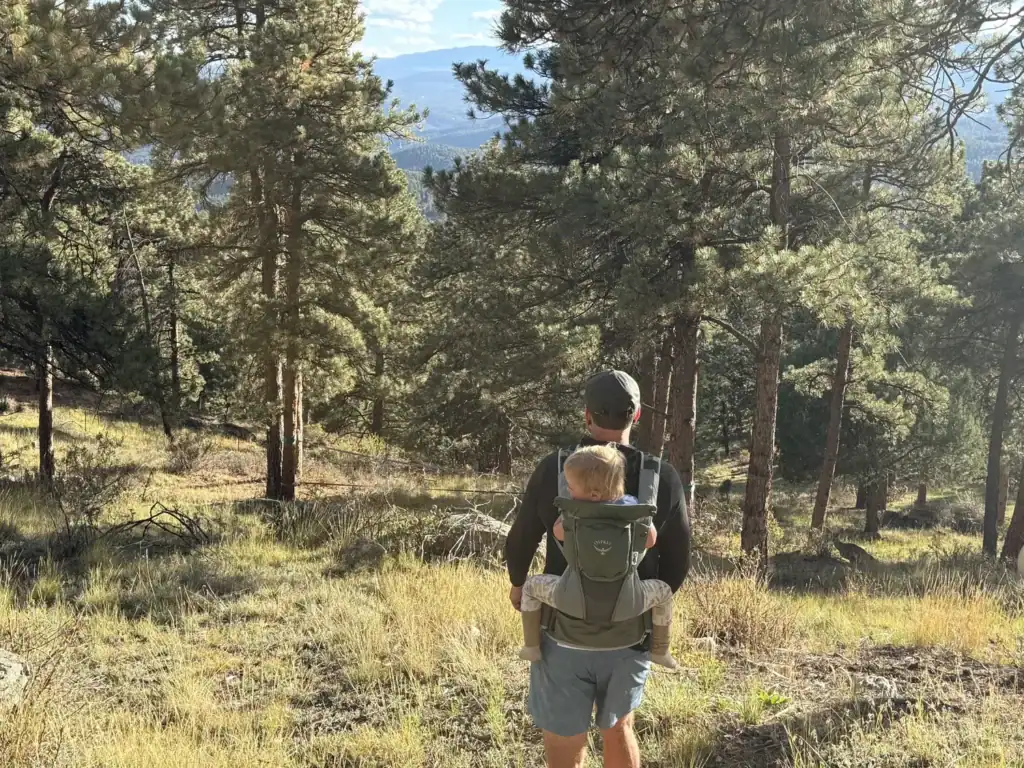
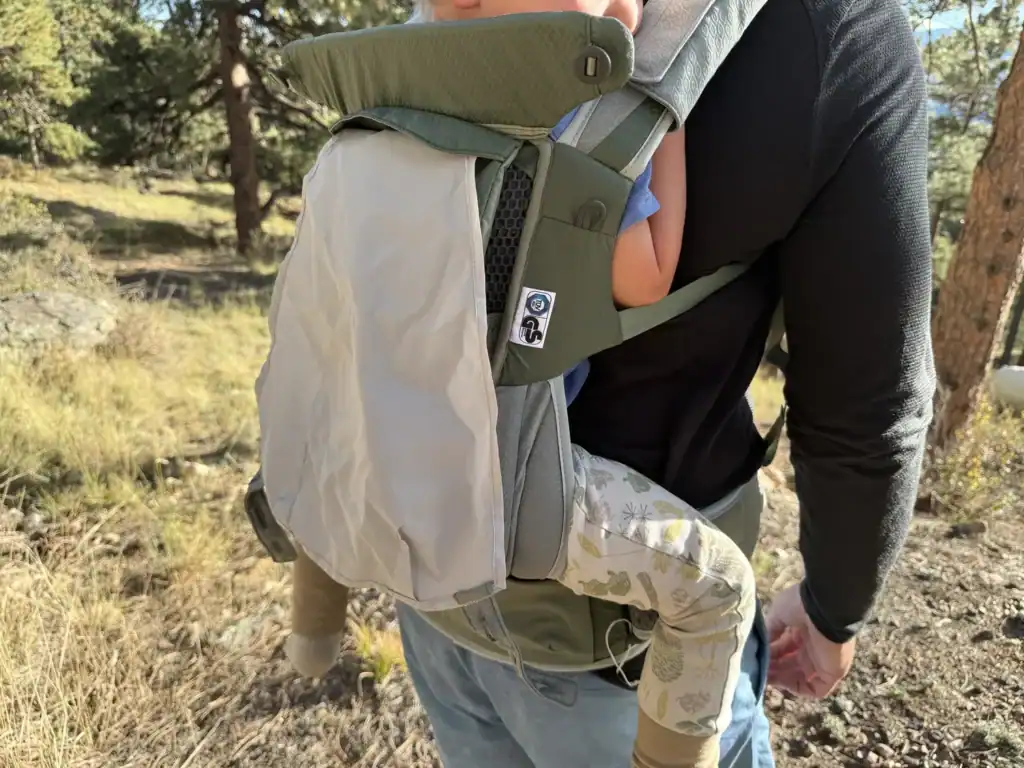
The short version: The soft carrier that actually gets hiking, for $120 less than the cheapest framed carrier here. Just bring your own water and a sun hat.
Rank 5
#5. Best for travel
Osprey Poco SLT
The one that travels. It folds down smaller than any framed carrier we've tested, so it's easy to toss in the trunk or bring on a trip. Just know you'll be taking it off to grab a snack.
Pros
- Folds smallest of the framed carriers
- Lightest framed carrier here
- Hydration sleeve
Cons
- Sunshade sold separately ($35)
- No pockets you can reach while wearing it
- Less comfortable on long days
Weight: 4.72 lb | Load range: 23.7 to 48.5 lb | Volume: 22 L | Torso adjustment: 6 in | Tested with: Oren, age 2, about 29 lb
Not right for you if: You want all the accessories and extras built in, since the sunshade is sold separately and there’s nothing you can reach while it’s on your back. And skip it if you want a more substantial carrier that stays comfortable on longer hikes. One of the beefier frames above will treat you better on big days.
We drive down to Baja every winter and camp on the beach, towing a camper the whole way. When space is that tight, every bit of gear has to earn its spot. The SLT folds down smaller than any other framed carrier we’ve used, so it’s the one that makes the trip.
Once we’re there, it spent a lot of time on our backs. We used it to carry Oren from our campsite into San Ignacio for dinner, around the streets of Mulegé, and on hikes from our beach camp on Bahía Concepción. It’s light enough that we didn’t think twice about grabbing it.
We kept the SLT to lighter loads. Osprey rates it all the way to 48.5 lb, but it felt most at home with kids around Oren’s size, and for heavier kids we’d reach for one of the beefier frames above.
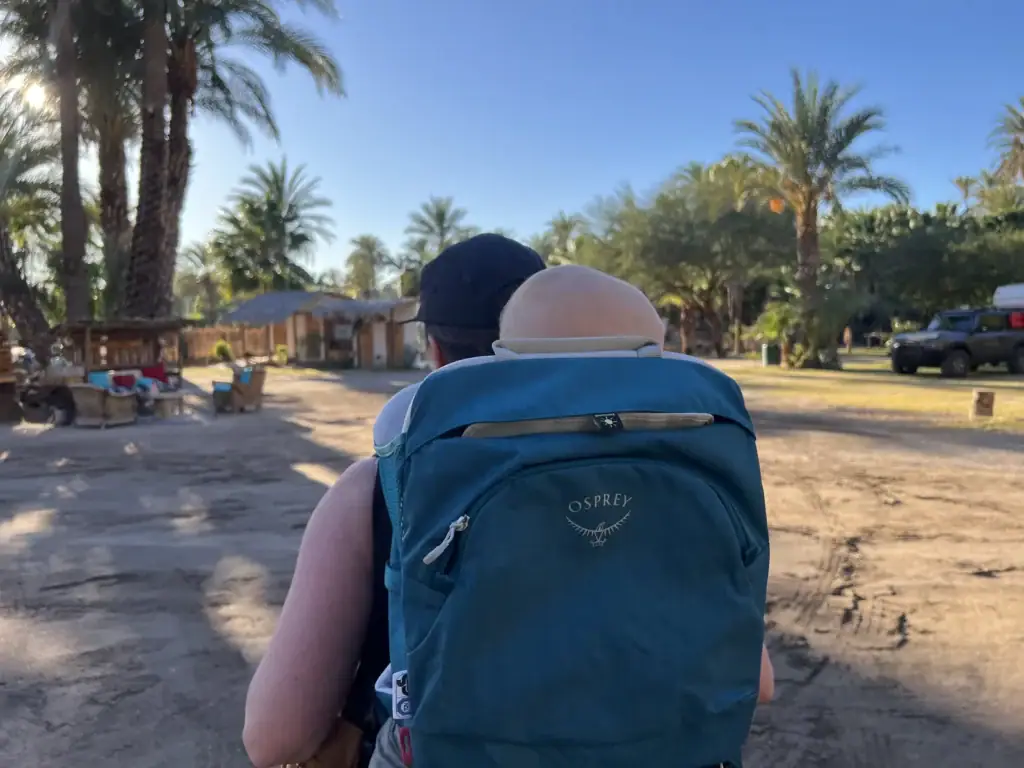
The short version: The framed carrier that fits where the others won’t. Add the sunshade, keep it to shorter days, and it’s a great travel buddy.
How the Best Child Carrier Backpacks Compare
| Carrier | Overall | Price | Type | Carrier weight | Brand-listed limits | Fit range | Volume | Sunshade |
|---|---|---|---|---|---|---|---|---|
| Deuter Kid Comfort | 4.8 | $330 | Framed | about 7.1 lb | about 48.5 lb (22 kg) child, plus about 4.4 lb (2 kg) gear | about 5’2″ to 6’5″ caregiver height | 14 L | Included |
| Osprey Poco Premium | 4.5 | $450 | Framed | 8.34 lb | 23.7 to 48.5 lb load range | 6 in of torso adjustment | 36 L | Included |
| Kelty Journey PerfectFIT Elite | 4.5 | $399.95 | Framed | 7 lb 4 oz | 16 to 40 lb child; 48.5 lb kid, gear and pack | 15.5 to 21 in torso | 26 L | Included |
| Osprey Poco Soft | 4.2 | $160 | Soft | 1.68 lb | 7 to 33 lb load range | Not listed | Not listed | Included (hood style) |
| Osprey Poco SLT | 4.0 | $280 | Framed | 4.72 lb | 23.7 to 48.5 lb load range | 6 in of torso adjustment | 22 L | $35 extra |
Heads up: each brand counts its weight limit differently. Kelty includes the kid, gear and the pack itself. Deuter lists the kid and the gear separately. Osprey gives a “load range” without saying what’s in it. Compare the limits with that in mind.
So Which Child Carrier Backpack Should You Buy?
If you just want us to tell you which one, buy the Deuter Kid Comfort. Otherwise, match it to how your family hikes:
Most families: Deuter Kid Comfort, $330. The easiest to live with for you and your kid.
You love a pocket for everything: Kelty Journey PerfectFIT Elite, $399.95. The most features, plus a torso you can adjust while you’re wearing it.
Long days, big loads, sleepy kids: Osprey Poco Premium, $450. The most storage and the best nap setup, if you don’t mind the weight.
Tightest budget or a lighter kid: Osprey Poco Soft, $160. A real hiking soft carrier, for kids up to 33 lb.
Road trips and tight spaces: Osprey Poco SLT, $280, plus $35 for the sunshade. The framed carrier that fits where the others won’t.
Shorter or slimmer caregivers: Deuter Kid Comfort Active SL, $280. We’ve tested it, and its Slim Line fit is built for you.
Frequently Asked Questions About Child Carrier Backpacks
Why isn’t the Thule Sapling on this list?
Our kids never settled in it. It’s built to be comfortable and ergonomic, and plenty of other testers rate it highly, but it never seemed comfortable for our kids, so we didn’t want to recommend it. If you’re considering one, try it with your own kid before you commit.
How old does my kid need to be for a backpack carrier?
Old enough to sit up on their own with good head and neck control. Deuter puts that around 8 months for most kids. Each carrier also has a minimum weight, like 16 lb for the Kelty, so check both.
When will my kid outgrow it?
The Poco Soft tops out at 33 lb. The framed carriers here go to about 40 to 48.5 lb, depending on the carrier and how the brand counts it. Our older son, at about 39 lb, could still ride in the Deuter, Kelty and Poco Premium, but those were short rides.
Do I really need a sunshade?
In our book, yes. Your kid is sitting still up there with nowhere to hide. Every carrier here includes one except the Poco SLT, where it’s $35 extra.
Is a $300-plus carrier really worth it?
If you’ll use it on real trails, we think so. The budget carriers we tried didn’t hold up to our standards, and one broke on its second use. If price is the sticking point, start with the Poco Soft at $160.

Ben Dawson
I'm Ben Dawson: dad of two, former full-time van liver, and co-author of three Falcon Guides, including Hiking with Kids: Glacier and Waterton Lakes National Parks. I've worked in outdoor media for more than a decade, and I've been testing gear with Roxy since 2017 as a gear reviewer and analyst. These days most of my testing happens with a kid on my back or a tent full of them. I've carried and hiked with my kids more miles than I can count, from Canada to Mexico and plenty of places in between. My rule is pretty simple: if the kid is uncomfortable, or you are, nobody's having a good time out there. I tell you what works, what doesn't, and who it's actually for.
More posts by Ben